Last updated: 8 September 2026 · Reviewed by the Feel Supreme Nutrition Team · 12 min read
Quick answer
The supplements with the strongest evidence for joint health are curcumin (from turmeric), omega-3 fatty acids, vitamin D3, vitamin K2, and collagen peptides. Curcumin and omega-3 work on the inflammation side of joint pain, vitamin D3 and K2 support the bone underneath the joint, and collagen helps rebuild the cartilage that cushions it. For faster daily comfort, many people layer in CBD and mineral-rich adaptogens like shilajit and ashwagandha.
Not sure where to start? Skip to the Feel Supreme joint stack for a ready-made routine.
Why your joints hurt in the first place
Before you buy a single capsule, it helps to know which type of joint problem you're dealing with. Supplements aren't interchangeable, a supplement that calms inflammation won't rebuild worn cartilage, and a cartilage-support supplement won't do much for a hot, swollen knee.

Joint discomfort tends to fall into three buckets:
- Inflammatory joint pain — driven by the immune system. Joints feel hot, swollen, and often worse in the morning. Rheumatoid arthritis and general low-grade inflammation sit here. Best supported by: curcumin, omega-3, CBD.
- Degenerative (wear-and-tear) joint pain — the cartilage cushion between bones gradually thins. Most commonly osteoarthritis. It worsens with activity, eases with rest. Best supported by: collagen peptides, glucosamine, hyaluronic acid.
- Bone-related joint pain — what feels like a joint problem is sometimes weak bone beneath it. Low vitamin D, poor calcium metabolism, and reduced bone density all cause aching around joints. Best supported by: vitamin D3, vitamin K2, magnesium, mineral-rich foods.
Most people over 40 have some combination of all three, which is why a stack tends to work better than a single supplement. We'll get to combinations further down — but first, what actually goes in the stack.
The 8 supplements that actually help joints
1. Curcumin (turmeric) — the most-researched joint anti-inflammatory
Curcumin is the active compound in turmeric that gives it its yellow colour. A 2021 review of 10 high-quality studies published in BMJ Open Sport & Exercise Medicine found curcumin reduced pain and improved function in people with knee osteoarthritis, and in three of those studies, it was equally effective as NSAIDs like ibuprofen without the gut side effects.
The catch: curcumin on its own has poor bioavailability. Your gut barely absorbs it. Piperine (from black pepper) increases absorption by roughly 2,000%, which is why every serious curcumin supplement pairs the two.
Typical dose: 500–1,000 mg curcuminoids daily with piperine, taken with a fatty meal.
Timeline: Most people notice a difference in 4–8 weeks.

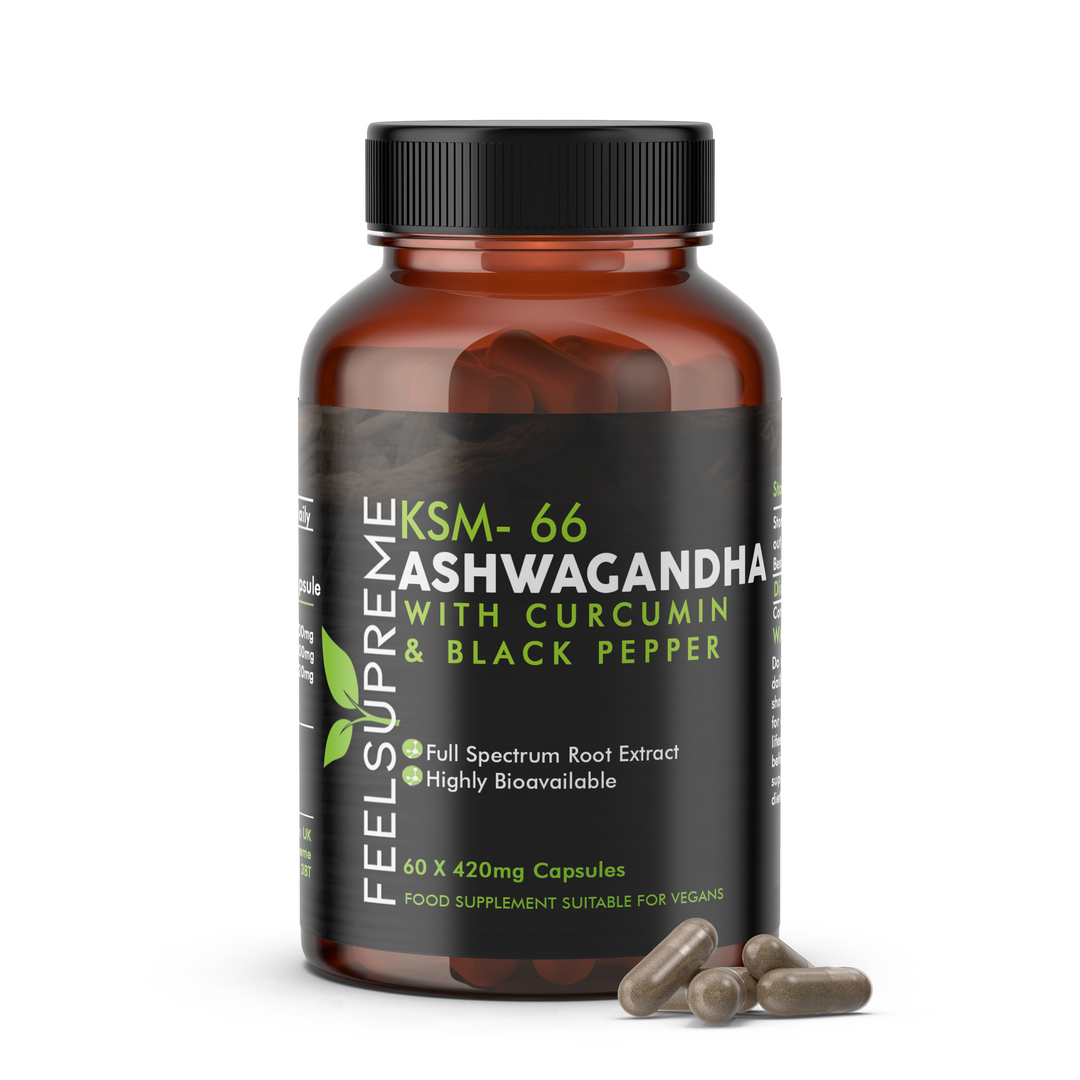
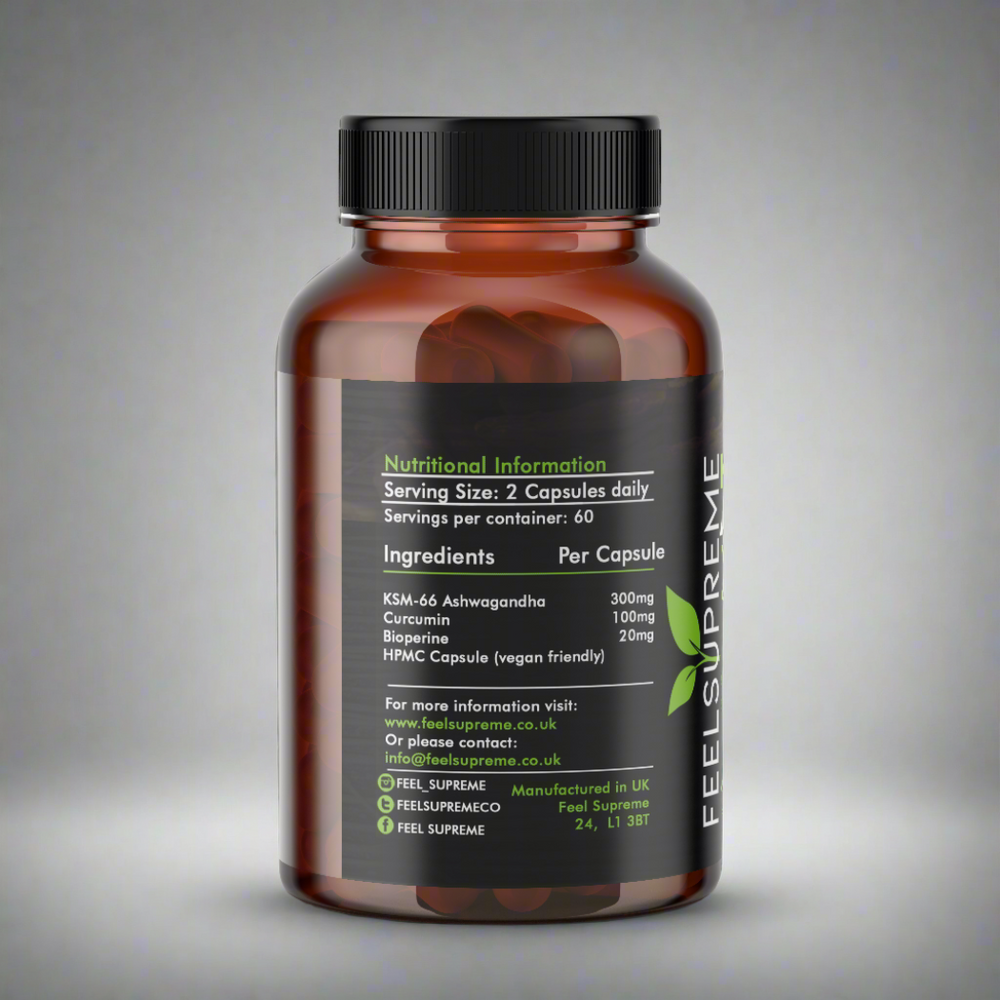
Feel Supreme pick: Our KSM66 Ashwagandha with Curcumin combines 100 mg curcumin with 300 mg patented KSM-66 ashwagandha and 20 mg black pepper extract — targeting both the inflammation side of joint pain and the stress-cortisol side that quietly makes it worse.
2. Omega-3 fatty acids — for whole-body inflammation
The omega-3 fats EPA and DHA reduce the production of inflammatory prostaglandins throughout the body. That matters for joints because chronic low-grade inflammation is often the reason "healthy" joints still ache after 40.
Evidence is strongest for rheumatoid arthritis, moderate for osteoarthritis. According to the Versus Arthritis UK charity, several studies show fish oil reduces morning stiffness and the number of tender joints in people with RA.
Typical dose: 1,000–2,000 mg combined EPA + DHA daily.
Timeline: 4–6 weeks.
Vegan alternative: Algae-based EPA/DHA delivers the same active fats without the fish.
3. Vitamin D3 — the bone-and-joint foundation you probably lack
You cannot build strong bones without vitamin D. Low vitamin D means poor calcium absorption, softer bones, and — for many people — a diffuse ache around the joints that mimics arthritis but resolves once levels are restored.
Here's the UK-specific problem: between October and March, sunlight is too weak at British latitudes to make meaningful vitamin D through skin. The NHS officially recommends that everyone in the UK consider a daily 10 microgram vitamin D supplement during autumn and winter, and year-round for people with darker skin or limited sun exposure.
Typical dose: 1,000–4,000 IU daily (25–100 mcg). Higher end for confirmed deficiency, under GP guidance.
Timeline: Symptoms of deficiency ease within 4–6 weeks of daily use.
Feel Supreme pick: Our Vitamin D3 5000iu gives a therapeutic dose in one small daily tablet — enough to correct most winter shortfalls without needing a blood test.
4. Vitamin K2 (MK-7) — sends calcium where it belongs
Vitamin D3 helps you absorb calcium. Vitamin K2 tells your body where to put it. Without enough K2, calcium can end up deposited in arteries and soft tissue instead of bone, which is why serious clinicians pair the two.
K2 activates a protein called osteocalcin, which binds calcium into the bone matrix. Stronger bone equals more stable joints. If you're taking vitamin D3, K2 is a natural companion.
Typical dose: 90–200 mcg MK-7 form daily.
Timeline: Bone density changes take 6–12 months to measure, but the pairing is a long-game investment.
Feel Supreme pick: Our Vitamin K2 MK7 uses the bioactive MK-7 form — the version with the longest half-life and best evidence for bone support. Take it alongside D3 for the full stack. Read more about how K2 works.
5. Collagen peptides — for the cartilage itself
Cartilage is roughly 70% collagen. As we age, we produce less of it, and existing cartilage thins. Hydrolysed collagen peptides — collagen broken down into small, absorbable fragments — have shown genuine cartilage benefit in clinical trials at 10 g daily over 8 to 12 weeks.
Collagen is not something Feel Supreme currently produces (we focus on plant-based formulations), so if this is a priority for you, look for a hydrolysed marine or bovine collagen with third-party testing. As a plant-based alternative, our Vitamin C from natural extracts supports your body's own collagen synthesis — vitamin C is a required cofactor for the enzyme that stitches collagen fibres together.
Typical dose: 10 g hydrolysed collagen peptides daily.
Timeline: 8–12 weeks.
6. Glucosamine and chondroitin — the classic, but read the evidence carefully
Glucosamine and chondroitin are the two most-marketed joint supplements globally. Both are components of cartilage. The evidence is genuinely mixed — the NHS notes that some people report benefit while trials show inconsistent results, particularly for chondroitin.
Key point most articles miss: glucosamine sulphate (the form used in most European trials) has better evidence than glucosamine hydrochloride (cheaper, common in US products). If you try it, look for the sulphate form at 1,500 mg daily and give it 8 weeks before deciding.
Feel Supreme doesn't currently formulate glucosamine or chondroitin — the evidence isn't strong enough for us to recommend it as a first-line choice, and we've focused our range on ingredients with clearer clinical support. If you want to try it, high-street pharmacies stock it widely.
7. CBD — for the pain, not the underlying cause
CBD (cannabidiol) doesn't heal joints, but it changes how you experience joint discomfort — both by interacting with the endocannabinoid system and by modulating inflammation locally when applied topically. It's why so many customers reach for it on bad-flare days.
The evidence base is younger than curcumin's or omega-3's, but a 2022 systematic review in the Journal of Cannabis Research concluded that oral CBD showed measurable reductions in chronic non-cancer pain across multiple trials. Anecdotally, it's one of the most-loved products in the Feel Supreme range for exactly this use case.
Typical dose: Start at 10–25 mg oral CBD daily, adjust upward over 2–3 weeks.
Timeline: Some effect within days; steady benefit over 2–4 weeks.
Feel Supreme pick: Our CBD Oil range starts at 500 mg full-spectrum for daily use and goes up to 1,500 mg for people with heavier pain loads. If you prefer targeted relief, our CBD in MCT Oil delivers a fast-absorbing dose in a fatty carrier that improves uptake.
8. Shilajit — the trace-mineral joint cofactor
Shilajit is a tar-like resin that seeps from high-altitude rocks in the Altai and Himalayan mountains, formed over centuries from decomposed plant matter. It's traditionally used in Ayurvedic medicine for what practitioners call "vitality", and modern analysis explains part of why.
Pure shilajit contains fulvic acid plus roughly 80 trace minerals — including magnesium, zinc, selenium, and small amounts of the boron and copper your body needs for connective-tissue enzymes. It's not a joint supplement in the classic sense, but the mineral matrix supports the systems that keep joints working: bone remodelling, cartilage synthesis, and cellular repair.
Typical dose: 300–500 mg resin daily, dissolved in hot water.
Timeline: Subtle changes in energy and recovery within 2–4 weeks.
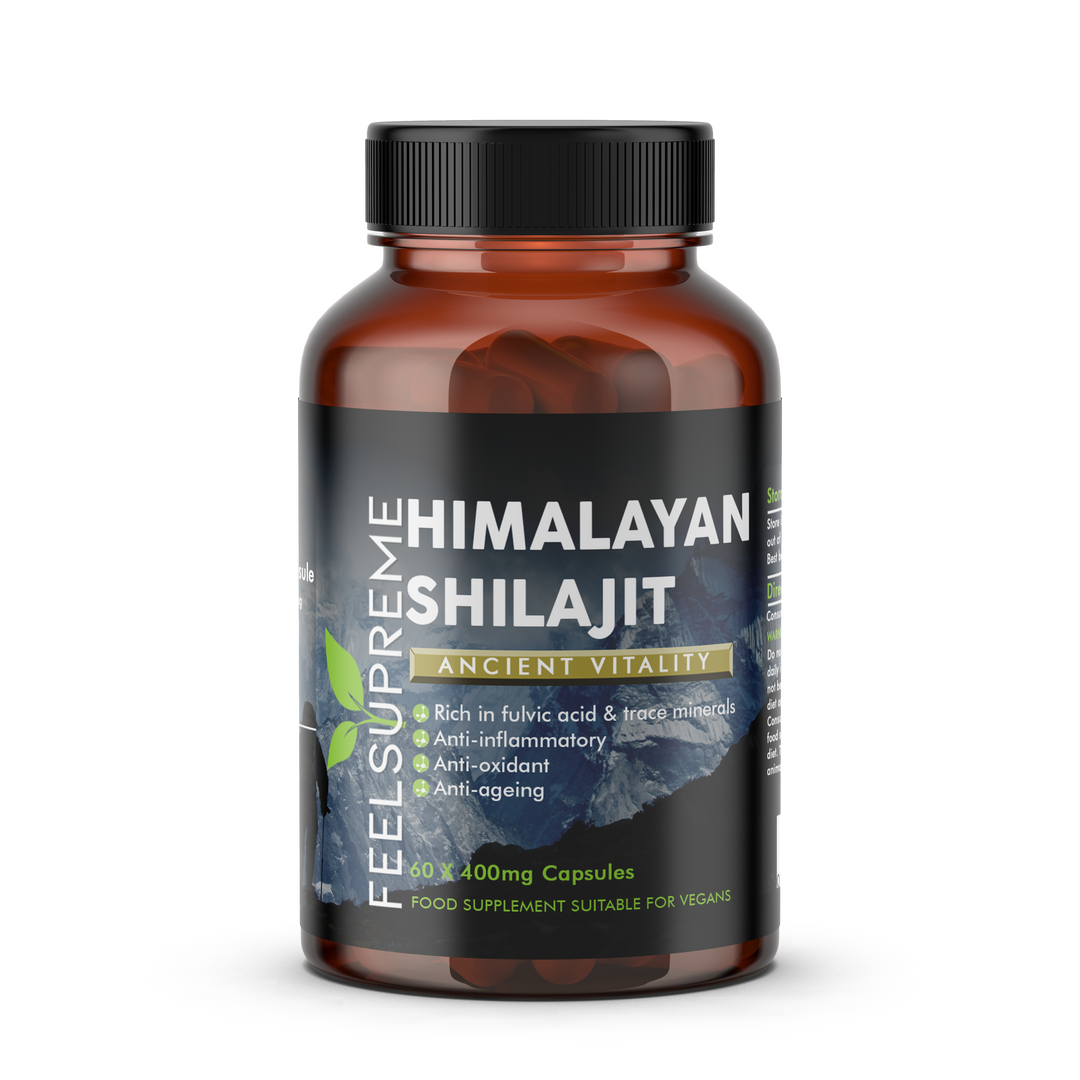
Feel Supreme pick: Our Altai Shilajit Resin is 100% pure, sourced from the Altai mountains, and independently tested for heavy metals — the single most important thing to verify with shilajit, since low-quality resin can contain unsafe mineral loads. Read the full shilajit benefits guide.
How the ingredients compare at a glance
| Supplement | Best for | Evidence | Time to work |
|---|---|---|---|
| Curcumin | Inflammatory pain, OA | Strong | 4–8 weeks |
| Omega-3 | RA, general inflammation | Strong (RA), moderate (OA) | 4–6 weeks |
| Vitamin D3 | Bone-related joint ache | Strong (if deficient) | 4–6 weeks |
| Vitamin K2 | Bone density (pair with D3) | Moderate to strong | 3–12 months |
| Collagen peptides | Cartilage support, OA | Strong | 8–12 weeks |
| Glucosamine sulphate | OA, cartilage | Moderate, mixed | 6–8 weeks |
| CBD | Pain modulation | Growing | Days to 4 weeks |
| Shilajit | Mineral cofactors, recovery | Emerging | 2–4 weeks |
The synergy piece most guides skip
Single supplements rarely fix joint discomfort on their own because the problem itself is rarely single-cause. A knee that hurts at 45 is usually part inflammation, part cartilage change, part accumulated stress, and part low-grade nutritional gap. Stacking supplements that address different mechanisms tends to outperform doubling the dose of one.
Three combinations with the best evidence:
- D3 + K2 — Vitamin D moves calcium into your blood; K2 moves it into your bones. Taken separately, they compete; taken together, they cooperate.
- Curcumin + black pepper (piperine) — Piperine raises curcumin absorption by around 20x. Any curcumin without it is largely wasted money.
- Curcumin + ashwagandha — Cortisol (your stress hormone) drives systemic inflammation. Ashwagandha lowers cortisol; curcumin blocks inflammatory pathways downstream. This is the pairing in our KSM66 + Curcumin product.
For the wider inflammation picture, our guide on what causes chronic inflammation and how natural supplements can help covers the systemic side in more depth.
What supplements can't do
Being straight with you: no supplement rebuilds a joint that's already worn to bone-on-bone. What supplements can realistically do is slow the trajectory, reduce day-to-day discomfort, and support the tissues around the joint so it stays functional longer.
See a GP promptly if you have:
- A joint that is hot, red, and visibly swollen
- Sudden severe joint pain with no obvious cause
- Morning stiffness lasting more than an hour
- Joint pain accompanied by fever or unexplained weight loss
- Any joint problem that's been getting worse for more than six weeks
These can be signs of rheumatoid arthritis, gout, or infection — all of which need a proper diagnosis, and none of which supplements alone will resolve.
The Feel Supreme joint stack

If you want a routine built from what we actually make, here's what we'd suggest — layered by how quickly each part contributes.
The foundation (take daily, long-term)
- Vitamin D3 5000iu — one tablet each morning
- Vitamin K2 MK7 — one capsule with the D3
- KSM66 Ashwagandha with Curcumin — two capsules with food
The daily-life layer (for when pain flares)
- CBD Oil 500 mg — a few drops under the tongue, morning and evening
The mineral base (rotational, for recovery and vitality)
- Altai Shilajit Resin — pea-sized amount in warm water, most mornings
For a broader look at how we approach anti-inflammatory support across the range, browse the full anti-inflammatory supplements collection.
Ready to build your joint routine?
Explore the full anti-inflammatory range — 100% natural, vegan-friendly, made in the UK.
Shop the anti-inflammatory range →
FAQ
What is the single best supplement for joint pain?
If you had to pick one, curcumin (from turmeric) has the strongest evidence across the widest range of joint conditions. It reduces the inflammatory pathways that cause pain and stiffness, and multiple trials show it performing as well as NSAIDs for knee osteoarthritis. It works best with piperine (black pepper) to fix its poor absorption.
How long do joint supplements take to work?
Most joint supplements need 4 to 12 weeks of daily use to show a measurable effect. CBD can work within days for pain modulation. Curcumin and omega-3 typically take 4 to 8 weeks. Cartilage-support supplements like collagen and glucosamine take the longest — usually 8 to 12 weeks before you'll notice a change.
Can I take all these supplements together?
Most of the supplements in this guide are safe to combine, and several work better together (vitamin D3 with K2, curcumin with piperine, curcumin with ashwagandha). Speak to a pharmacist or GP before combining supplements if you take blood thinners, blood pressure medication, thyroid medication, or if you're pregnant or breastfeeding.
Are joint supplements safe with medication?
Most are, but there are important interactions to be aware of. Omega-3 and vitamin K2 can affect blood clotting, so speak to your GP if you take warfarin or similar anticoagulants. Curcumin can interact with diabetes and blood pressure medications. Ashwagandha may affect thyroid medication. When in doubt, ask a pharmacist — they check for interactions for free.
Do I need glucosamine and chondroitin?
Not necessarily. The evidence for glucosamine is moderate and mixed — some people find real benefit, others notice nothing. If you want to try it, choose glucosamine sulphate (not hydrochloride) at 1,500 mg daily and give it 8 weeks. If nothing has changed, the evidence suggests it probably isn't going to.
Is there a supplement that rebuilds cartilage?
No supplement fully rebuilds worn cartilage — the tissue has very limited natural regeneration. What some supplements can do is provide the raw materials (collagen peptides, vitamin C, glucosamine) and reduce the inflammatory environment (curcumin, omega-3) that's actively degrading the cartilage you still have. Slower loss is a realistic goal; regrowth generally is not.
Are natural joint supplements better than ibuprofen?
They work differently. Ibuprofen gives fast, strong pain relief but can damage the gut lining and kidneys with long-term use. Supplements like curcumin and omega-3 work more slowly but address the underlying inflammation rather than just masking pain, and are safer over months and years. Many people use a combined approach — supplements as the daily base, occasional ibuprofen for flare-ups.
Sources and further reading
- NHS — Vitamin D recommendations for the UK
- NHS — Osteoarthritis treatment guidance
- Versus Arthritis — Fish body oil evidence review
- Daily et al. (2016) — Efficacy of turmeric extracts and curcumin for alleviating symptoms of joint arthritis. Journal of Medicinal Food.
- Paultre et al. (2021) — Therapeutic effects of turmeric or curcumin extract on pain and function for individuals with knee osteoarthritis. BMJ Open Sport & Exercise Medicine.
- Arthritis Foundation — Supplement and herb guide (US-based reference).
- Stanford Lifestyle Medicine — 5 supplements for joint health
This article is for educational purposes only and is not a substitute for medical advice. Food supplements are not intended to diagnose, treat, cure, or prevent any disease. Always speak to a GP or pharmacist before starting new supplements if you take prescription medication, are pregnant, or are managing a diagnosed health condition.